Get the latest score from Howlin' Wolf Records “DON'T GO IN THE HOUSE”, “HOLIDAY HELL” and “GOOD TID

Showing posts with label Caldera Records. Show all posts

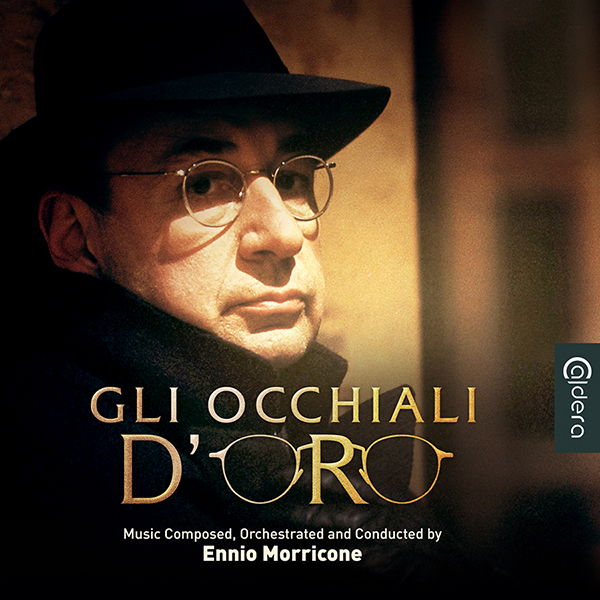
Caldera Records: "GLI OCCHIALI D'ORO" music by Ennio Morricone


Giuliano Montaldo's adaptation of Giorgio Bassani's novel tells several stories at once. The title – Gli occhiali d'oro ("The Gold Rimmed Glasses") – was carefully and intelligently chosen. The over-arching subject is, after all, blindness. Or seeing, depending on how one chooses to look at it. One story-line concerns a doctor (played by Philippe Noiret) who is respected as long as he hides his homosexuality. Another deals with a young Jewish man (played by Rupert Everett) who recognizes the threats Mussolini and Hitler pose in the Italy of the 30s. Against these stories of individuals, is one of communal blindness, of intelligent, educated and sensible citizens being lured by fascism. At another level, Gli occhiali d'oro is a scathing critique of the hypocrisy of the upper classes, in which everybody lives behind a facade to uphold their reputation and standing.

Though now difficult to find, Giuliano Montaldo's Gli occhiali d'oro was revered by critics when it came out in 1987. It won the David di Donatello Award for Best Music. The whole score is one of Morricone's most carefully crafted, a tender composition that not only manages to capture the grim atmosphere of the film, its dread and sorrow, but also enhances it, encapsulating the painful loneliness felt by its two protagonists. Gli occhiali d'oro is comprised of several themes: the main theme, which plays over the opening credits; the love theme for David and Nora; the comparatively upbeat "A Cena Con I Ragazzi", the forlorn and trepidatious "Persecuzione Storica"; and the yearning and desolate "Ricordo Del Ghetto".
 
For More Information: [CLICK HERE]
 
One you can never go wrong with anything that has Ennio Morricone name on it, second Caldera Records always brings us scores that will move our ears and last you can refer to one and two again. That being said the score "GLI OCCHIALI D'ORO" is a charming piece filled with levels of touching emotions that is wrapped well around the film's plot design. This score I believe was released once before about 20+ years ago, a sought off collectable for Morricone fans and it's now remastered from Caldera Records. Want to be moved? Get this score!

Jeremy [Six Strings]

Caldera: "MAN OF GOD" music by Zbigniew Preisner


Caldera Records is proud to present Zbigniew Preisner’s score for the motion picture “Man of God” from 2021, directed by Yelena Popovic.

Popovic’s biopic chronicles the most turbulent years in the life of a man who had made it his mission to serve others and improve the conditions of those in need: Saint Nektarios. Popovic’s film shows how Nektarios helps the poor and destitute, provoking three objectors within the church turn to the bishop’s patriarch Sophronios. No longer wiling to hide their anger at Nektario’s servitude towards sinners and harlots, his enemies claim he will bankrupt the church and usurp the patriarchy. Without trial, Nektarios is convicted and exiled from Egypt in 1891. 
 
Particularly because of his deep love for Greece, its culture and people, Zbigniew Preisner was delighted to score “Man of God” – and agreed to do so without having read the script. From the beginning, it was clear to Preisner he wanted to use a choir – a Byzantine one. After some searching, he collaborated with the Choir of Chanters, “The Maestros of the Psaltic Art” (Οι Μαΐστορες της Ψαλτικής Τέχνης), one of the most famous Byzantine Choirs. Following their collaboration of “Valley of Shadows”, Zbigniew Preisner and Lisa Gerrard worked together again. The latter recorded her sung parts – written by her – in Australia. Furthermore, Preisner felt it the right choice to use Greek instruments.... for more information: http://caldera-records.com/

This score is simply stunning, I have listened to this one several times now and Zbigniew Preisner never lets us down musically. I find myself being moved listening, FANTASTIC!
Jeremy [Six Strings]

Caldera Records: "BEYOND THE NIGHT/THE PRINTING" music by Dwight Gustafson


Caldera Records is proud to present Dwight Gustafson’s scores for the motion pictures “The Printing” and “Beyond the Night”, directed by Tim Rogers and Katherine Stenholm respectively.

“Beyond the Night”, from 1983, tells the story of John and Bettie Dreisbach, passionate missionaries who first worked in Nigeria tending to leprosy patients and spreading the word of Christ in an area that was nearly exclusively Muslim. For close to ten years, the Dreisbachs served as ministers in the Sahara, before the government forced them to leave. “Beyond the Night” describes the couple’s time in the Sahara Desert. Dwight Gustafson’s themes are infused with discreet elements from African music such as the rhythmic drumming in the “Titles”, specific tone sequences particularly popular in Northern African music (“Trip to the Village”) and a heavy use of grace notes in the woodwinds (“Clinic Day”). What binds the score together is Gustafson’s strong main theme, first heard in the “Titles” and later through diverse variations heard in the course of the movie/score. In its sweeping nature, the theme has a folkloric Americana quality that echoes the works of Aaron Copland and even the spiritual compositions of Alan Hovhaness.

“The Printing” tells the story of hardship experienced by Christians in the cause of their faith. This time, the story is set in the Soviet Union and celebrates Christian believes who, despite being threatened by the communist government which had made it its mission to stifle Christian belief, dared to openly worship the Lord. Not only do the heroes of this film refuse to abandon Christ, but they continue to secretly print Bibles, convinced that God will protect them from the evil schemes of the communists. Gustafson’s music here is as moody and gray as the architecture of communist-era Russia – where incidentally, the composer can also be seen in the film, playing a pastor. Unusually for him, he utilizes a synthesizer and subtle suspensions to introduce his main theme, a downbeat yet still lyrical melody in a minor key that later blossoms through variations that the composer develops during the course of the score. His delicate, sophisticated orchestration remains evident throughout. [http://caldera-records.com/]
 
Jeremy [Six Strings]

Caldera Records: "Forgotten We’ll Be" music by Zbigniew Preisner


Caldera Records is proud to present Zbigniew Preisner's score for the motion picture "Forgotten We’ll Be" from 2020, directed by Fernando Trueba. 

Trueba’s acclaimed film is inspired by Héctor Abad Faciolince’s memoir “Oblivion: A Memoir” in which he describes with great tenderness the life and work of his father, the revered Colombian scientist and activist Hector Abad Gómez who was killed by mercenaries in 1987. Adapted by Trueba’s brother David, the film focuses on two major time periods: the 70s and mid-80s. While the latter part – shot in black and white – mainly deals with Gómez’ political agenda and achievements, the scenes set in the 70s – shot in color – paint Gómez as a devoted family man. They also describe the turmoil experienced by him and his family through the hands of his young son Hector who runs over a woman in his car and throws stones through the window of a Jewish family’s home. 

After their collaboration on “The Queen of Spain”, “Forgotten We’ll Be” marked a new collaboration between the revered director and renowned composer Zbigniew Preisner. “Forgotten We’ll Be” is similar to other Preisner scores released by us at Caldera Records – namely “Valley of Shadows” and “Lost and Love” in that childhood and the loss of childhood innocence play a pivotal role. “Valley of Shadows” and “Forgotten We’ll Be” are even partly told from a child’s point of view. Hence there was no question that Preisner’s score for Fernando Trueba’s most recent film should capture themes of childhood musically. Hence, the composer devised gentle and yet poignant themes for orchestra, choir and solo instruments such as the harp which features prominently in one of Zbigniew Preisner’s most haunting and touching scores.

The 43rd CD-release of Caldera Records – a world premiere – features a detailed booklet-text by Stephan Eicke and elegant artwork by Luis Miguel Rojas. The CD was mastered by Leszek Kaminski and produced by Stephan Eicke and John Elborg.

For more information and sound clips, please visit: [CLICK HERE]

An innocence that fits the tone of the film, but strength that lets the score by composer "Zbigniew Preisner" stand on it's own. As the score progresses it takes a heavy turn and holds your attention and at the same time still maintains the inner-power of it's purity. Caldera Records has had a great relationship with Zbigniew Preisner over the several releases, it continues well with this score "Forgotten We'll Be" and we love it. Well done, well done indeed!

Jeremy [Six Strings]

Caldera Records: "CHRONICLE: WERNER HERZOG FILM SCORES" music by Ernst Reijseger


Since his first international success “Aguirre” premiered in 1972, German director Werner Herzog has made a name for himself as a maverick, a rogue director who accepts any and every challenge to put dreams on screens – obsessions of primarily men who decide to go against society and nature. There is, for example, Brian Fitzgerald who wants to build an opera house in the middle of the jungle. There is also Timothy Treadwell, the Grizzly Man, who shuns a society that has not recognized his greatness. Instead, he decides to live among bears. There is also Graham Dorrington who builds a special airship. He says he wants to explore the rain forest but in truth, he wants to exorcise his personal demons. The list of extraordinary people who have been put on film by Herzog is endless – both in fiction and documentary though that distinction is a slippery slope here.

For 15 years, Werner Herzog has worked with cellist and composer Ernst Reijseger. It was he who penned the music for films as colorful as “The White Diamond”, “My Son My Son What Have Ye Done”, “Cave of Forgotten Dreams” and, most recently, “Fireball.”

Ernst Reijseger is an internationally celebrated cellist. His music knows no boundaries and is therefore hard to categorize. Reijseger rejects labels such as world music despite the fact that he has worked for over a decade with Senegalese singer and poet Mola Sylla and Dutch pianist Harmen Fraanje, with Indonesian and Sardinian ensembles, accompanying their traditional folk music with skillful improvisations on his instrument that at times sounds like a didgeridoo, percussion, but rarely like a cello, so inventive his playing is. Is it world music? Is it jazz? Is it avant-garde? Does it matter? It’s unlike anything you have ever heard.

The 42nd CD-release of Caldera Records, released in collaboration with Spring Music Productions, features a detailed booklet-text by Stephan Eicke, an interview with Werner Herzog as a bonus track, and elegant artwork by Luis Miguel Rojas. The CD was mastered by Niels Brouwer and produced by Ernst Reijseger, Stephan Eicke and John Elborg. 
 
For more information: http://caldera-records.com/
 
Okay, one of the greatest compilations this year, one of the greatest covers of all time and one of the greatest interviews on the end of this CD. I would be lying if I said HERZOG wasn't one of my favorite director/everything, but he is. Add in the music and you have to share this music by the always talented composer Ernst Reijseger. In the end we have a great starting point for these two and their story, their journey if you will and what we have is just something great. Bravo!
Jeremy [Six Strings]

Caldera Records: "Stanley Kubrick’s films “Fear and Desire” and “Day of the Fight” music by Gerald Fried


Caldera Records is proud to present Gerald Fried’s music for Stanley Kubrick’s films “Fear and Desire” and “Day of the Fight”.

Gerald Fried and Stanley Kubrick became friends as teenagers. The musician enabled the latter to join a baseball team while the future director served as the conduit for Fried to join intellectual circles. They would first collaborate professionally in 1951, when Kubrick needed music for his short film, “Day of the Fight.” A year previously, the photographer had portrayed boxer Walter Cartier for Look magazine, and henceforth decided to make him the subject of a moving picture. “Day of the Fight” follows Cartier during the hours preceding a seminal fight, with the tightly focused 12-minute documentary including trivia from the boxer’s life, as narrated by Douglas Edwards.

Then in 1952 Kubrick started to develop his first feature film, a drama he saw as a poetic allegory about a man lost in a hostile world. “Fear and Desire” – describing the two dominant human passions – is not to be taken literally, as it depicts the struggle of four soldiers who find themselves behind enemy lines. As opposed to opening the film with a boisterous main title fanfare (as he had done in “Day of the Fight”), he used only a solo bassoon to introduce the theme, reminiscent of Stravinsky’s famous opening of “Le Sacre du Printemps.” Kubrick loved this approach and showered his friend with compliments during the recording. Fried set out to write a profound, meaningful, touching, despairing and yet triumphant score – which he duly achieved and with which he paid tribute to the film’s qualities.

Incidentally, and although he had ended their working-relationship in 1957, Kubrick was very much inspired by a film Fried worked on in 1964: “To the Moon and Beyond” was produced for the World Fair in 1964/65 in New York. The short film, narrated by “Twilight Zone” creator Rod Serling, depicted a voyage “to the moon and beyond,” showing the earth continually shrinking while the camera zooms further and further out. Because of its Kubrick connection, we included the score for “To the Moon and Beyond” here.

The 41st CD-release of Caldera Records – a world premiere – features a detailed booklet-text by Stephan Eicke and elegant artwork by Luis Miguel Rojas. The CD was mastered by Richard Moore and produced by Stephan Eicke and John Elborg. [http://caldera-records.com/]
 
What can I say other than this is score is years in the making and composer Gerald Fried shows the skills in one of his earliest works. This score is preserving history not only for the future Kubrick and Fried's projects, but making themselves known in their respected fields. As for the score itself, we are thrown back into the 50's with the top down on our Chevrolet Bel Air cruises the strip. Okay I wasn't there in that time, the score is the tops and you should head over to CALDERA RECORDS!
Jeremy [Six Strings]

Caldera Records: "Sostiene Pereira" music by Ennio Morricone


Caldera Records is proud to present Ennio Morricone’s music for Roberto Faenza’s film “Sostiene Pereira”.

When Antonio Tabucchi’s novel “Sostiene Pereira – Pereira Maintains” in the English language – was published in 1994, it became an immediate literary sensation. The novel’s leading character is the titular Pereira, a newspaper editor who is responsible for compiling the paper’s cultural pages. However, Pereira is not interested in publishing his political views. If all of Portugal was out on the streets demonstrating against the government, Pereira would quietly sit at home and read a good book. He is not a supporter but an enabler. His political reluctance is challenged when he meets a young man named Rossi. Pereira’s life soon changes radically.

Screenwriter and director Roberto Faenza was a perfect choice to turn the novel into a feature film. The Italian film maker had for decades depicted revolts against tyrannical governments. Here, he cast Marcello Mastroianni as the overweight editor who suffers from a heart problem. Popular French actor Daniel Auteil played Pereira’s doctor, Nicoletta Braschi (“Life is Beautiful”) and Marthe Keller (“Marathon Man”) were splendidly cast in minor roles.

The director had tasked Ennio Morricone with writing music for his feature debut “Escalation” in 1967, and they had worked together ever since. By 1995, their collaboration spanned seven films, eight including “Sostiene Pereira.” The latter is one of Morricone’s most ingenious works for a Faenza film. It is intricate and subversive, subtle and stimulating. For the first time, the composer worked with Portugese singer Dulce Pontes when they recorded the song “A brisa do coração” which makes its appearance several times in the film and is presented here both in its original form and in a shorter, edited version. His score subtly features Fado, a Portugese style of music in which a woman as the singer is accompanied by one or two guitars. Morricone’s score consists of several themes and motifs the composer cleverly weaves together. “Sostiene Pereira” starts with a rhythmic pattern for wood blocks, one that recurs throughout the score and serves as its backbone before several instrumental groups consecutively join in with various motifs. The score is intricately developed in that Morricone uses all these various separate elements in other cues but in different arrangements and constellations.

Ennio Morricone’s rich and vibrant score was released on CD in 1995. In collaboration with Sony Music Germany, we are proud to re-release it with detailed liner notes by Stephan Eicke, featuring Christopher Slaski’s precise transcription of the film’s main theme for study purposes. The 40th CD-release of Caldera Records also features elegant artwork by Luis Miguel Rojas. The CD was produced by Stephan Eicke and John Elborg. [http://caldera-records.com]

Gorgeous! There is really nothing I can say that you shouldn't know when we are talking about the maestro "Ennio Morricone" and the many years of talent he brought us in his lifetime. Caldera Records got the great opportunity to re-release a classic that is a hard one get your hands on and being we lost Morricone this year. It's time for you to seek this one out, it's glorious piece of cinematic history and will be forever a classic piece.
Jeremy [Six Strings]

Caldera Records: "VERA DRAKE" and "ALL OR NOTHING" music by Andrew Dickson


Caldera Records is proud to present Andrew Dickson’s music for Mike Leigh’s films “Vera Drake” and “All or Nothing”.

“All or Nothing” tells the story of a family whose members spend their days working at essential and yet low-paid jobs. Penny, played by Lesley Manville, is the main breadwinner as a cashier in a supermarket. Her partner Phil, played by Timothy Spall, drives a cab around town after years of unemployment due to his crippling depression. Living in a council flat with their two children Rachel (Alison Garland) and Rory (a young James Corden), Penny and Phil have resigned themselves to their life on the treadmill. With his music, written for  violin, viola, double bass, flute, bass flute and two guitars, Dickson chose to enhance the somewhat desolate nature of some of the characters.

Although “All or Nothing” was well-received critically, it is Mike Leigh’s most underappreciated film as it stands in the shadow of the director’s next work, “Vera Drake”. Vera Drake (Imelda Staunton) is a cleaner in post-war Britain, while her husband Stan (Phil Davis) works in a garage. Although they don’t have much money, they are optimistic. Having survived – and won – the Second World War, things were looking up for the United Kingdom. The worst seemed to be behind it. However, Vera keeps a secret from their family that eventually threatens to destroy their bond. At the Venice Film Festival, “Vera Drake” won the prize for Best Film before it was nominated for eleven BAFTAs, one Golden Globe and three Oscars.

While it is hailed as one of Leigh’s major works, it is also the crowning opus of Andrew Dickson’s film career. By then, he and the director had already worked together for more than 20 years. For the first time in their films, Dickson and Leigh decided to use a choir. For the folk-like main theme of the film, Dickson used the germ of a sinister song about a fairground he had written previously and which had been performed by a 15-year old P.J. Harvey, a Mercury Prize-winning singer with whom Dickson performed in his local band in Bridport.

Also included on this CD are selection from Andrew Dickson’s scores for “Someone Else’s America’ and “Oublie-Moi”. The 39th CD-release of Caldera Records – a world premiere – features a detailed booklet-text by Stephan Eicke and elegant artwork by Luis Miguel Rojas. The CD was mastered by Richard Moore and produced by Stephan Eicke and John Elborg. [http://caldera-records.com/] 
 
Jeremy [Six Strings]

Caldera Records: "ANGELICA" music by Zbigniew Preisner


Caldera Records is proud to present Zbigniew Preisner’s score for the motion picture “Angelica” from 2015, directed by Mitchell Lichtenstein.

“Angelica” also tells a story of female empowerment. It is based on Arthur Phillips’ book of the same name, published in 2007, and adapted for the screen by Lichtenstein. Set in the Victorian age in England, Phillips and Lichtenstein describe the trials and tribulations of Constance (played by Jena Malone), a young woman who falls in love with a successful scientist. Their romance blossoms and leads to marriage. Eventually, a child is born, a girl they name Angelica. The birth is grueling, and Constance nearly loses her life. For her, everything changes in an instant: she is told in no uncertain terms by her doctor that she is to refrain from engaging in vaginal sex (and therefore become a “hortus conclusus”) – otherwise she will risk her health and quite possibly leave her daughter motherless. From this moment Constance goes into a downward-spiral.

Zbigniew Preisner’s music pays tribute to the elegant romanticism of the 19th century, while at the same time weaving more experimental elements into it. The composer decided against creating specific leitmotifs for the individual characters. Instead, his music follows the story as it progresses. Hence, Preisner developed variations on the themes as demanded by the story. For example, there is no theme for Constance per se. Preisner follows her journey with various motifs and themes, divided into what the composer calls the “courtly” and the “modern.”

The 38th CD-release of Caldera Records – a world premiere – features a detailed booklet-text by Stephan Eicke and elegant artwork by Luis Miguel Rojas. The CD was mastered by Leszek Kaminski and produced by Stephan Eicke and John Elborg. [http://caldera-records.com]
 
Haunting and mysterious score by composer who always brings and maintains the main theme throughout the whole score and brings the score together. Subtle sadness with the guitar only to a ghostly piano that brings it all to one place and that place holds your attention. ANGELICA by composer great Zbigniew Preisner brings another worthy piece to the already growing catalogue of soundtracks.
 
Jeremy [Six Strings]

Caldera Records: "MAN AT THE TOP" music by Roy Budd


Caldera Records is proud to present the original score for the motion picture “Man at the Top” from 1973, directed by Mike Vardy, featuring music by Roy Budd.

Writer John Braine established Joe Lampton as a ruthless force to be reckoned with when he published his novel “Room at the Top” in 1957. The film rights were snatched up immediately, and only two years later, Jack Clayton’s adaptation premiered in theaters. Following another outing in the cinema and a television series, Anglo-EMI, in collaboration with Hammer Films, decided to let Joe Lampton (now played by Kenneth Haigh) loose on the big screen once more. In 1973, “Man at the Top” premiered. Here, Joe Lampton is appointed Managing Director of ChemExport, a company overseen by Lord Ackerman, played by Harry Andrews. All is not well: six months later, it emerges that Lampton’s predecessor committed suicide. Slowly it becomes clear to Lampton that he might have been appointed to take the blame for a massive marketing blunder that could crush not only him but the whole company. [http://caldera-records.com]

Made up of some serious tones, that makes a bold statement and strong on guitar work. Composer Roy Budd seams to bring the light and reflections at times and holds our attention and then comes the BOSSA NOVA. Wonderful release. Ah thank you.
Jeremy [Six Strings]

Caldera Records: "ONE POTATO TWO POTATO" music by Gerald Fried


Caldera Records is proud to present the original score for the motion picture “One Potato, Two Potato” from 1964, directed by Larry Peerce, featuring music by Gerald Fried.

Peerce’s film, one of the first to discuss an interracial relationship openly in cinema, tells the story of a young single-mother named Julie (played by Barbara Barrie) who cares for her daughter all by herself after her husband abandoned her. Struggling with everyday life, she strikes up a friendship with Frank (Bernie Hamilton) who seems supportive and kind, giving Julie a respite from the nastiness she’s had to endure. It doesn’t take long for the two of them to fall in love. Although Julie and Frank are aware of the problems they are likely going to face as an interracial couple in the 60s, they decide to marry. Society, however, does not wish to grant them their happiness.

Surprising for an independent film without any major studio backing, “One Potato, Two Potato” scored an Oscar nomination for its screenplay.

As beloved as his music for both “Star Trek” and “The Man from U.N.C.L.E.” is, composer Gerald Fried considers “One Potato, Two Potato” one of his best works. It is a score which is dear to his heart, not least because the film tackles a subject that the composer felt strongly about. The memorable main theme makes several appearances throughout the album, at times playful and jaunty, at other times tense and introspective. As a contrast, Fried developed a sorrowful and yet warm lament as accompaniment for both Julie and Frank who try to overcome the various prejudices and other hurdles society presents them with. While there are several other motifs and themes in the score, the nursery rhyme serves as the backbone of the whole composition. [http://caldera-records.com/]

It's what you would expect from composer Gerald Fried, getting the full on treatment of whimsy and then to serious tones. Gerald Fried and Caldera Records get an A++ and + for this 1964 score, you all need to seek this one... it's worth it!
Jeremy [Six Strings]

Caldera Records: "FLAME IN THE WIND/SHEFFEY" music by Dwight Gustafson


Caldera Records is proud to present the original scores for the motion pictures “Flame in the Wind” and “Sheffey” from 1971 and 1977 respectively.

Both films were produced by Unusual Film, a division of Bob Jones University in Greenville, South Carolina. “Flame in the Wind” is set during the time of the Spanish Inquisition and follows a young man named Carlos who is faced with a conflict throughout the course of the motion picture: should he, horrified by the Inquisition, follow the Bible, or adhere to religious tradition?

“Sheffey” was an even bigger undertaking, a lavish and expensive production: Born in 1820, Robert Sheffey was a Methodist evangelist who spent his lifetime taking care of those in need, traveling through Virginia and Tennessee and preaching the word of God.

The music for both films was composed by Dwight Gustafson. Born in 1930, Gustafson was named acting dean of the School of Fine Arts at BJU at 24. He served as administrator, taught, composed, conducted and preached until his retirement in 1997.

The music for “Flame in the Wind” is based around three themes which recur throughout the score, which was issued on an LP by Unusual Films in 1971. Gustafson wrote a leitmotif for the film’s hero Carlos which is supposed to reveal the pathos and heroism of the young man as he tries to find his way. The second theme, a rather eerie, instrumental melody for the Inquisition expresses the repression and terror for which the inquisitors are responsible, while a triumphant chorale seeks to honor the true believers who have lost their lives due to their faith in Jesus Christ during the Spanish Inquisition.

“Sheffey” follows a different musical conception, although Gustafon’s style is unmistakable. Since the film, through the life of Robert Sheffey, tells the story of folk religion, Gustafson decided to employ various folk tunes as seemed appropriate to backbone for his score.

Both “Flame in the Wind” and “Sheffey” were composed, orchestrated and conducted by Dwight Gustafson and recorded with the Bob Jones University Symphony Orchestra, composed of students and faculty. LPs of both scores were made available by Unusual Films/BJU to coincide with the film releases.

The 35th Caldera CD features a detailed booklet-text by Stephan Eicke and elegant artwork by Luis Miguel Rojas. The CD was mastered by Richard Moore and produced by Stephan Eicke and John Elborg. [http://caldera-records.com/]
 
Richness, 70's-esque sounding and rather moving scores by composer Dwight Gustafson who I had not heard of until this release. Style on "FLAME IN THE WIND" is pretty heavy on the strings which I love, worth it for sure. Onto "SHEFFEY" feels to be more upbeat, I seem to be weighing in on liking this score better... though both are very well done.
Jeremy [Six Strings]

Caldera Records... Gets NAKED and More!


Caldera Records is proud to present a selection of Andrew Dickson’s music for Mike Leigh’s films, most notably “Naked” from 1993.  Mike Leigh is one of the most revered film-makers in British cinema. Over a span of nearly 50 years, he has garnered 7 Oscar nominations, 14 BAFTA nominations (winning four), a Palme d’Or, a Golden Lion, and countless other prestigious awards. He had already shot “Bleak Moments” and several BBC productions when, in 1981, he met Andrew Dickson. Their collaboration would become one of the most fruitful ones between composers and directors: For “Meantime,” broadcast in 1983, Dickson chose to use a tack piano and a saxophone. The composer has always liked the idea of different instruments representing different people, and piano and saxophone somehow seemed perfect for a film about two brothers in a housing project. [http://caldera-records.com/]

As we head to the end of the year, we get this treat and what I call a musical project that we needed from Mike Leigh's collective works by composer Andrew Dickson. As the music tells a story from each project, I am finding a pleasant jazz feel into strong guitar that is only built up by the rest of the instruments. Then towards the end of the music, it's subtle yet memorable to the ears and this serves as a solid collection of music.
Jeremy [Six Strings]

Caldera Records: "LOST AND LOVE" muisc by Zbigniew Preisner


Caldera Records is proud to present Zbigniew Preisner’s score for the motion picture “Lost and Love” from 2015, directed by Sanyuan Peng.

“Lost and Love” tells a harrowing (and apparently true) story of loves lost. The love described in the film is the love between parents and their children. Andy Lau plays against type by portraying Lei, a poor fruit-grower. For 15 years, he has been searching for his child, traveling through the vast country in the hope of being united with his offspring. On his way from one end of China to the other, he meets up with a young mechanic who goes by the name of Zeng Shuai as played by Jing Boran. The latter is also searching, although not for his child but for his parents.

For her feature film debut, Sanyuan Peng chose Zbigniew Preisner as composer who wrote one of his very best works, a delicate and yet passionate score which is rich in themes and variations. Its most prominent theme is – fittingly – a lullaby which opens the album. It is a melody which recurs throughout the score in different metamorphoses. Not only did it fit the images on screen, it also captured the overall topic of the film. The main theme, as already briefly laid out in the prominent lullaby, can be heard most prominently in “Lost and Love – Main Theme”, carried by strings, while echoes of it feature in “Retrospective”. It is reincarnated in a variation for flute, guitar, harp and orchestra in the “End Credits”, which offer a glimpse of hope to the characters in the film and therefore the audience when it is given a passionate coda. [http://caldera-records.com/]
Stunning theme, with a score that features so much musical character and it needs to be heard. I found myself enjoying each track, from next to next... it was worth it.
Jeremy [Six Strings]

Caldera Records: "BIRDS DO IT, BEES DO IT" music by Gerald Fried


Narrated by Lee Bergere, a beloved actor who had guest roles in every major television series in the 60s (including “Star Trek”), “Birds Do It, Bees Do It” examines the reproductive habits of bacteria, frogs, lions, kangaroos, elephants, monkeys, birds, rhinos, and others by showing in graphic detail how animals behave before, during and after sexual intercourse. The documentary did not shy away from its sensitive topic. Instead, it discussed sex as a natural part of life and aimed to educate its viewers. In fact, several college campuses decided to show the film to its students in the mid-70s, using the moving images of copulating animals as an educational tool.

Fried had already worked on a number of Wolper productions when he was offered to score the documentary. It would be one of the most satisfying experiences of his career. Not only was he not subjected to a hair-rising deadline, he also had sufficient funds to execute his creative vision. When he saw the rough cut for the first time, the germ of an idea evolved – human beings portrayed in the film would musically be treated with tonal themes (Man Intrudes), while animals would get less organized, less thematic, but nonetheless tonal music (Kangaroos). Insects would be portrayed with electronic music and/or percussion instruments (Talking Insects), amoebas only with noises produced by synthesizers (Primal Ooze). In 1976, “Birds Do It, Bees Do It” received an Oscar nomination for Best Dramatic Score. It failed to win, but Gerald Fried’s glorious music for Birds Do It, Bees Do It stands the test of time and is not only one of Fried’s very best scores but also one of the best scores ever written for a documentary. [http://caldera-records.com]
 
Great score, some tracks are little freaky [good way]... I was listening as I worked around my house and at some-point I was immersed in the music I stopped working. It's been a very long time since I was taken away into the music, very nice. "Birds Do It, Bees Do It" glowing example of a score that makes music stand out and above the rest.
Jeremy [Six Strings]

Caldera Records: "Ambition" music by Leonard Rosenman


One of the stars of the film is, undoubtedly, a man behind the scenes: Leonard Rosenman. It was clear to Rosenman and Scott Goldstein that the score should have a progressive, rather than conventional harmonic structure. They agreed that this would help to underscore Merrick’s (the antagonist) horrific, troubling visions and this approach would help capture his state of mind musically. Goldstein suggested Rosenman play him some of his concert music as a blueprint for “Ambition”. Encouraged to be able to draw upon his “progressive” work for the concert stage, Rosenman presented Goldstein with “Foci”, a work for chamber orchestra that the composer had written in 1981 and revised in 1983. Goldstein loved what he heard and commenced to use “Foci” as temp music for “Ambition”. “Foci” is an atonal piece, complex and full of anxiety – exactly what Goldstein needed for his motion picture.

Honestly never heard of this film, but know the actors and definitely know the work of this composer. Starting out strong as we take the path of a little innocence, we begin to feel it's certain stength and musical intentions. Suspense and intrigue are as to follow, nice use of plotting sounds and a theme that hold their own. [http://caldera-records.com/]
Jeremy [Six Strings]

Caldera Records: "THE HISTORY OF ETERNITY" music by Zbigniew Preisner


Caldera Records is proud to present the score for the motion picture “The History of Eternity” from 2014, directed by Camilo Cavalcante, featuring music by Zbigniew Preisner.
 
The History of Eternity tells of not one, but three love stories. The focus is on three women: one of them is a teenager (Débora Ingrid), the second one is in her 40s (Marcélia Cartaxo) while the last one is in her 60s (Zezita Matos). The male cast consists of Bahian musician Léo França playing a blind accordion player. Irandhir Santos portraying a Sertanejo artist suffering from epilepsy. Claudius Jaborandy offers a counterpoint to these artists as a rather pragmatic man more concerned with material goods. The three stories happen simultaneously and intertwine, but are given separate titles: Chicken Foot, Goat Foot and Urubu Foot. [caldera-records.com]
 
The History of Eternity... sweeping with a gliding gentleness and another superb masterpiece by legendary composer Zbigniew Preisner released on Caldera Records. Finding it's way into your heart, every track brings a moving whisper into the light and we are drawn to see it from the darkness. This album plays heavy on the guitar and the theme that keeps you moving from start to finish and holds my attention. THANK YOU!
Jeremy [Six Strings]

Caldera Records: "THE BABY" Music by Gerald Fried


Caldera Records is proud to present the score for the motion picture “The Baby” from 1973, directed by Ted Post, featuring music by Gerald Fried.  The motion picture, marketed as a horror film, tells the story of a dedicated social worker takes on a case involving a grown-up man still in diapers. It doesn’t take long for the disturbed social worker to figure out that ‘Baby’s’ family deliberately keeps the retarded man-child from maturing. There are even more disturbing facts to note: the disappearance of previous social worker being the most unsettling. But lo and behold, the new social worker finds herself confronted with the ‘Baby’s’ family who, so it seems, is out to silence her. 

Gerald Fried’s music provides a phonic reminder that things may not be as presented; a harmonic harbinger of hidden dread. Fried’s resonantly descriptive dissertation is centered around a somber and melancholy etude, offered first in cello solo (performed by the esteemed Edgar Lustgarten), and expanded into a dreamlike lullaby, which sustains the film’s emotional capital throughout. This forlorn, needful melody acts as a guiding constant with the netherworld atmosphere created by Gerald Fried’s eerily sublime orchestration – a creepy and unsettling realm of threatening rattles, hypnotic chimes, and nightmarish music box tinkling. [http://caldera-records.com]

I remember seeing this film and before coining the phrase "WTF" well here is this film "THE BABY" [1973]. Wow I thought here is the one of those things you watch and then quickly shield your eyes. If I am going to take anything away from this film, it's going to be the score by composer Gerald Fried, who took us inside the head of the baby. Scaring us without being scared, showering us with chimes and a dabble of bells. A car seat to baby carriage... innocence takes a backseat, when you close your eyes and hearing this piece it will be in your heart. I think that made sense, if not then just listen to this score it's really worth it.
 
Jeremy [Six Strings]

Caldera Records: "VALLEY OF SHADOWS" Music by Zbigniew Preisner


Caldera Records is proud to present the score for the motion picture “Valley of Shadows” from 2017, directed by Jonas Matzow Gulbrandsen, featuring music by Zbigniew Preisner.

The story of “Valley of Shadows” was inspired by a wide variety of sources, mostly going back to the director’s childhood: “I am interested in fables and allegories, in mythology and children’s tales, these stories that we often believe are regional but are actually extremely universal, sometime with a moral and often with joyful gravitas. One example is Draumkvedet (The Dream Poem), a Norwegian ballad from the Middle Ages. I read a lot when I was a child – traditional stories of course – but especially Swedish literature for children. As a child, I thought a lot and was hungry to learn. Reading Bruno Bettelheim was also something that I draw greatly from.” [http://caldera-records.com/]
 
From the first note, I knew that I was going to be impressed by composer Zbigniew Preisner and this composer is not one to disappoint. It stares darkness in the face, with moving low tones and begins to sweep with a haunting choir. Followed up in the end with a track called "WAKE UP", that brings this whole release full circle with a solo singer's beautiful voice.
Jeremy [Six Strings]

Caldera Records: "CHILDREN OF PLANET X" Music by Christopher Young and Bob Badway


Caldera Records is proud to present Christopher Young’s and Bob Badway’s concept album “The Lost Children of Planet X”.

In the daily grind of film scoring, composers are often left with great bits of material that they love, but for various reasons were dropped from the scenes they were written for. Sometimes these pieces find new life in other films, sometimes they are buried forever, or sometimes they are resurrected – as in the case of Christopher Young and his latest album. Young’s re-working of these tracks into a concept album was something that started as a passion project, and it wasn’t until 2011 that this material was woven into the form we hear now.

Precursors and inspirations for the music/dialogue include In Held ‘Twas In I by Procol Harum and Frank Zappa’s Lumpy Gravy as well as the Beatles’ 45ers. From the world of classical music, the primary inspirations were Luciano Berio’s Laborintus II, Ages by Bruno Maderna, and Karlheinz Stockhausen’s Gesang Der Jünglinge. “The Lost Children of Planet X” is very much a spoken word drama, filled with surrealism and dream logic. Explains writer Bob Badway: “When you listen to the album, you get an overall picture of what’s going on, but have trouble visualizing it because the details are screwy and everything seems to be in total contradiction.” The album is filled with Easter eggs in terms of casting and the lines delivered. Young himself appears as the booming voice of King Everett, while also delivering a few odd quips here and there, including his personal favorite, ‘Help me God, please help me!’

As a bonus, eight purely instrumental tracks are included that accompany the adventures in space. “The Lost Children of Planet X” is a highly unusual album – not only for Young and Caldera Records. We hope that people will find great joy in going on this 80-minute psychedelic trip. We had a blast working on it.

The 27th CD-release of Caldera Records features a detailed booklet-text by Gergely Hubai, elegant artwork by Luis Miguel Rojas and Helmut „Dino“ Breneis, who provided the original illustrations. The CD was produced by Stephan Eicke and John Elborg. [http://caldera-records.com/]
 
A nice tribute to classic sci-fi films, a dash of Forbidden Planet,  drop of Forbidden Zone and sprinkled with a little crazy out of this world music! Trust me I have listened to it several times and I get a little more each time... it's worth it! It's MADNESS, in a good way!
Jeremy [Six Strings]